
"Someone asked, 'What is the risk of German companies investing in China?' The answer is very simple: the greater risk is not investing in China."
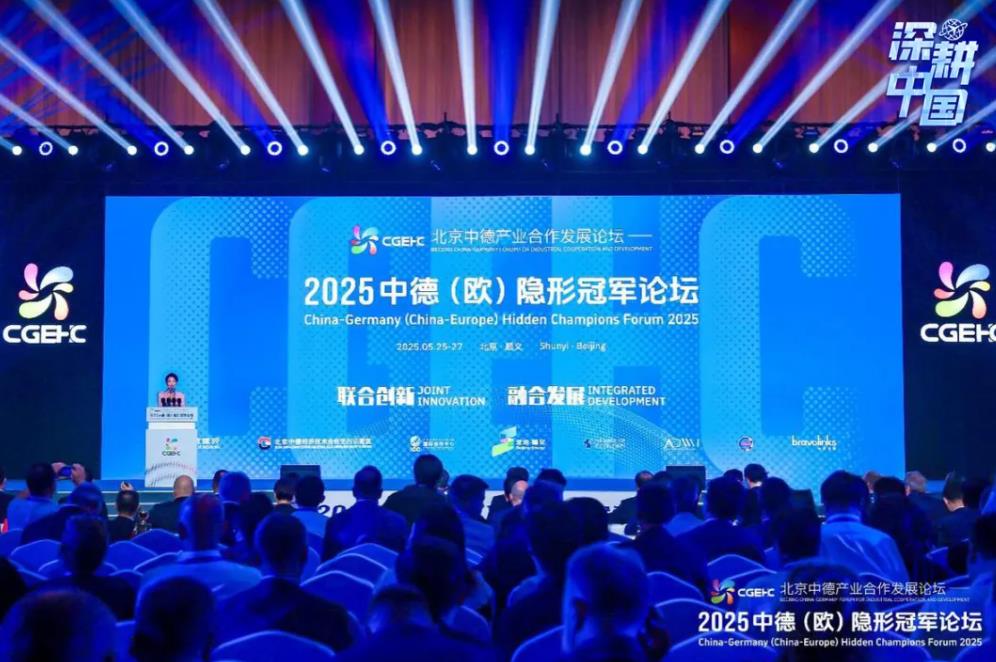
Recently, at the Beijing Sino-German Industrial Cooperation and Development Forum - 2025 Sino-German (European) Hidden Champions Forum held in Shunyi, Beijing, Hans-Peter Friedrich, former Vice President of the German Bundestag and Chairman of the German-Chinese Parliamentary Group of the German Bundestag, expressed his views on Sino-German cooperation in this way. Most heads of European enterprises interviewed by reporters believe that losing the Chinese market is equivalent to losing an important "foothold" in the world.
What Are "Hidden Champions"?
The answer lies in the two words themselves. "Hidden" means these enterprises are not well-known to the public; "Champions" means they occupy a globally leading position in a specific niche market.
A single valve, a target, or a pallet can drive a huge market - Germany's "Screw King" Würth Group is a typical example. The company only produces fasteners such as screws and nuts, yet it has hundreds of sales outlets in more than 80 countries around the world, and has established 38 related companies in China. According to statistics, there are 2,734 hidden champion enterprises worldwide, most of which are located in Europe, with 1,307 alone in Germany.
Last year, the long-established World Niche Market Leaders (World Hidden Champions) Summit left Germany for the first time and held the first Sino-German (European) Hidden Champions Forum in China. In other words, these enterprises chose China as the first stop for their "group overseas trips". This year, the number of overseas representatives coming to China for the forum has nearly doubled compared with last year. Walter Döring, Executive Chairman of the European Economic Senate and Chairman of the Organizing Committee of the German World Market Leaders (World Hidden Champions) Summit, told reporters, "Last year, the delegation I led had about 60 enterprises coming to China; this year, it’s more than 150. That says it all."
Why China?
Yang Ming, Vice Chairman of the European Economic Senate and Chief Representative of the German World Market Leaders (World Hidden Champions) Summit in China, believes that this is partly a natural market-driven result, and partly because as global economic uncertainties increase, many enterprises believe they must expand their reach further.
From a market perspective, cooperation with China is an inherent requirement for hidden champions to "establish themselves". In today’s highly globalized world, hidden champion enterprises, due to their focus on niche areas, must deploy globally to achieve the revenue level needed to support their development. As the world’s second-largest economy and a super-large market, China has become a "cake that cannot be lost". Bernd Plana, President of German Rhine Pharmaceuticals, said that he noticed in Germany that Chinese consumers are paying increasing attention to health and prefer herbal-based foods and medicinal materials - this represents huge consumption potential, so the company decided to enter the Chinese market.
For hidden champion enterprises that have already entered China, their fruitful gains have made them more convinced that this market has great potential.
Carlos Riveros, General Manager of German company Mutec, told reporters that his company has been selling products in China for 15 years, and the Chinese market currently accounts for about 20% of the company’s global market share. However, he still sees a "blue ocean": at present, the company mainly serves Chinese enterprises going global; as China vigorously promotes green transformation, domestic industrial gas companies have a huge demand for spare parts. Therefore, the company has formulated a "dual-track strategy": on the one hand, it is considering building production lines in China to strengthen local supply; on the other hand, it is deploying sales representatives to further expand the market.
To maintain competitiveness, hidden champion enterprises attach great importance to innovation. Data shows that their R&D investment is about twice the industry average. A key to innovation is to carry out R&D layout "around customers".
Currently, China has become the best application scenario for the new round of scientific and technological revolution and industrial transformation. Harald Enkebach, Director of the Würth Group in Germany, said that the company has invested 75 million euros to establish an R&D center in China and is cooperating with Chinese enterprises in AI research and development. German pump and system manufacturer Wilo Group stated that it plans to double its R&D capabilities in China by 2025. A report released by the German Chamber of Commerce in China shows that 51% of German enterprises plan to increase investment in the next two years, of which 87% aim to maintain competitiveness - an increase of 8 percentage points from the previous year.
When German "Craftsmanship Spirit" Meets China’s Magnetic Appeal
For many years, German hidden champion enterprises have been renowned for their rigorous "craftsmanship spirit". What kind of sparks will fly when they meet China’s magnetic appeal?
The industry generally believes that German hidden champion enterprises have world-leading foundations and technologies in manufacturing fields such as machinery and chemicals, while China has strong innovation capabilities in emerging fields such as new energy, artificial intelligence, and the digital economy - the two sides are highly complementary.

Among such collaborations, intelligent connected vehicles are a typical symbol of bilateral cooperation. German enterprises leverage their technological advantages in the traditional automotive field and combine them with China’s expertise in digital innovation and information and communication technologies to jointly overcome technical challenges. At the relevant thematic event, China and Europe jointly released the Beijing Initiative for China-Europe Intelligent Connected Vehicle Industry Cooperation and launched a three-pronged linkage plan covering technological breakthroughs, industrial upgrading, and market resonance to deepen cooperative innovation in this field.
Similar cooperation can also be extended to areas such as the digital economy and biomedicine to promote industrial upgrading on both sides; it can even use the Chinese market as a springboard to supply the global market, creating a "1+1>2" effect.
At the same time, the openness and stability of the Chinese market are crucial for hidden champions. Most of them are small and medium-sized enterprises; although they have a long history and profound accumulation, they are far inferior to large enterprises in terms of capital, talent, and risk resistanc