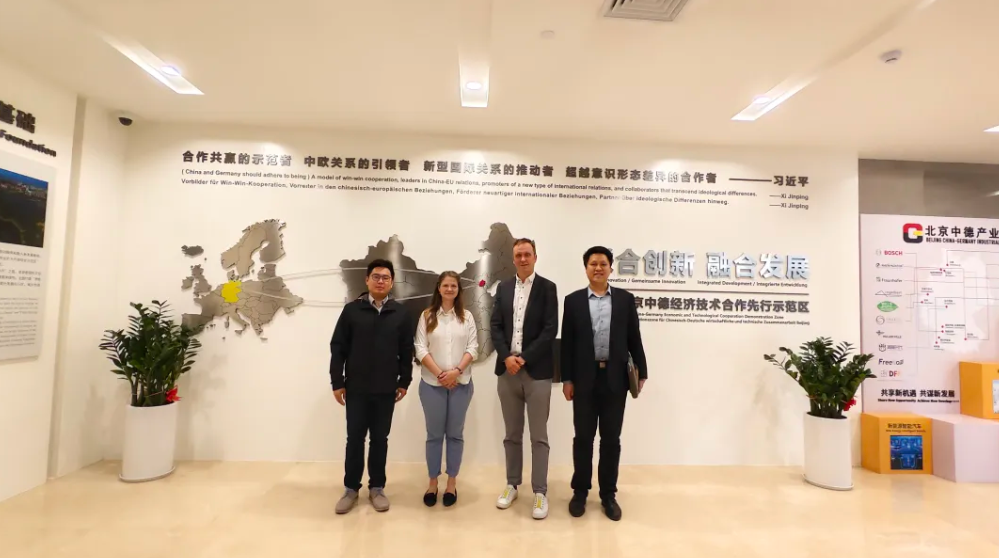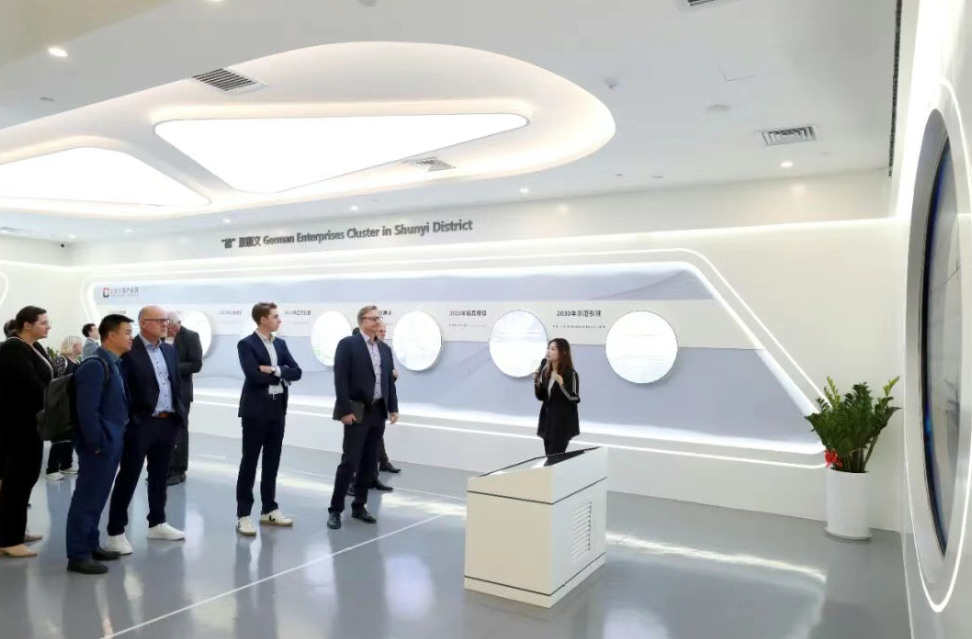

On the afternoon of June 5th, coinciding with World Environment Day, in order to jointly plan a beautiful blueprint for the healthy, stable, and sustainable development of Sino German enterprises, the 2023 Sino German Enterprise Sustainable Development Exchange Conference was held on the Bund of Shanghai, hosted by the Management Committee of Taicang High tech Industrial Development Zone in Jiangsu Province and the Hamburg Liaison Office in China.
Germany is the birthplace of the concept of "sustainability". In 1987, in the research report "Our Common Future" written by the World Commission on Environment and Development, the definition of "sustainable development" was officially proposed, which means "meeting the needs of contemporary people without compromising the ability of future generations to meet their needs.". After the concept of modern sustainable development was proposed, the German government attached great importance to sustainable development and elevated environmental protection and sustainable development to national strategies.
In the same context of time and space, Taicang, a small town in Jiangnan, China, which is located along both Shanghai and the Yangtze River, has been committed to developing economic and trade cooperation with Germany since the 1990s, attracting nearly 500 German enterprises to settle down. The development of Taicang over the past thirty years, while balancing economic takeoff with sustainable development in various aspects such as environment, society, and governance, can be said to be a microcosm of comprehensive cooperation between China and Germany. Looking ahead to the future, China and Germany have broad prospects for cooperation in areas such as digital economy, green and low-carbon, advanced manufacturing, and biopharmaceuticals. The cooperation between Taicang and German enterprises holds enormous potential.
Mao Yaping, the person in charge of Taicang High tech Zone, Pan Hua, the Chief Representative of Hamburg's Liaison Office in China, Jiang Jian, the Vice President of Bosch (China) Investment Co., Ltd., Lei Kaiting, the General Manager of Corporate Affairs of Beiersdorf Group, Per Linden, the President of the Swedish Chamber of Commerce in Shanghai, Cheng Huiling, the Chairman of Desilicon Group Co., Ltd. and Honorary Vice President of the China Association of International Friends, as well as representatives of more than 40 Chinese and European enterprises, attended the event.
Pan Hua, Chief Representative of Hamburg's Liaison Office in China, and Mao Yaping, Head of Taicang High tech Zone, delivered keynote speeches at the meeting. Pan Hua introduced Hamburg's future - sustainable development and new energy strategies; Mao Yaping introduced the sustainable development cooperation between China and Germany in Taicang High tech Zone as a case study.
Throughout the years, Taicang High tech Zone has been striving to create a "German ecosystem" that meets the development needs of German enterprises. While attaching great importance to economic development, it also attaches equal importance to sustainable development, environmental protection, and low-carbon development, benchmarking with international standards, and building a green and low-carbon city. Actively responding to the overall planning goals of carbon peak and carbon neutrality both domestically and internationally, we aim to create a low-carbon park with Taicang characteristics in China and Germany, and strive to achieve green and sustainable development of the park economy. In terms of GPD unit energy consumption, green industry layout, and pollution emission indicators, it has always been at the forefront of industrial parks in Jiangsu and even across the country.
Mao Yaping stated that from January to August last year, Taicang High tech Zone obtained a set of "completely opposite" data: during these 8 months, the high-tech zone achieved a total industrial output value of 78.393 billion yuan above designated size, a year-on-year increase of 7.1%. However, from January to August, the energy consumption per unit output value of the entire zone was 0.023 tons of standard coal/10000 yuan, a year-on-year decrease of 20.5%. The reason is that in recent years, the high-tech zone has vigorously promoted industrial energy conservation and consumption reduction, continuously promoted industrial transformation and upgrading, and carried out green transformation projects.
Taking Taicang's largest German company, Schaeffler, as an example, the company has been practicing the concept of green development for many years, creating automobiles, industrial products, and solutions that are in line with green development. In October 2017, Schaeffler Greater China launched the "zero discharge" project for industrial wastewater. At present, approximately 200 cubic meters of industrial wastewater are treated and reused through these facilities every day, with a reuse rate of over 85%. The company relies on the energy management system as a platform and actively promotes energy-saving renovation and solar power generation systems. Since 2021, Schaeffler has firmly implemented the medium and long-term energy-saving renovation plan. In 2021, the Schaeffler Taicang production base implemented 23 energy-saving renovation projects, including a series of measures such as optimizing the drying temperature of the heat treatment process and renovating the cleaning process at room temperature, achieving energy savings of 2.86 million kilowatt hours and reducing carbon dioxide emissions by 2151 tons per year. In 2022, the Taicang Schaeffler production base implemented 18 energy-saving renovation projects, which can save 2.93 million kilowatt hours of electricity and reduce carbon dioxide emissions by 2204 tons per year.
In April this year, Taicang High tech Zone attended the Sino German Carbon Peaking Event jointly organized by Bavaria and Karlsruhe Institute of Technology (KIT) in Germany, sharing the Sino German Energy Efficiency Network Group project, which attracted great attention. Currently, Taicang High tech Zone is also exploring long-term cooperation with KIT to jointly build a sustainable development model for circular economy and ecological industrial park in Taicang High tech Zone.